




Your Top Questions About Tin-Free Catalysts in DTM Coatings — Answered
February 11, 2026 | Blog
Direct-to-metal (DTM) coatings are expected to deliver fast drying, strong adhesion, long-term durability, and reliable corrosion resistance while meeting global regulatory requirements. Polyurethane coatings are popular for DTM applications due to their durability, versatility, and performance. However, as formulators look for alternatives to traditional tin catalysts for polyurethane systems that face regulatory restrictions, the need for solutions that balance performance, compliance, and production efficiency has never been greater.
To help make that transition easier, we gathered some of the most common questions we hear from formulators and explain how Borchi® Kat 2115, a next-generation tin-free catalyst, can support high-performance DTM systems for polyurethane coatings.
Q: Why are formulators moving away from traditional tin catalysts in DTM polyurethane coatings?
A: Tin-based catalysts like DBTDL have historically offered excellent reactivity and efficient curing. However, tightening regulations, particularly in regions like the European Union (EU), are increasing labeling requirements and environmental and regulatory scrutiny.
Formulators are now seeking tin-free alternatives that help simplify compliance while still delivering excellent performance.
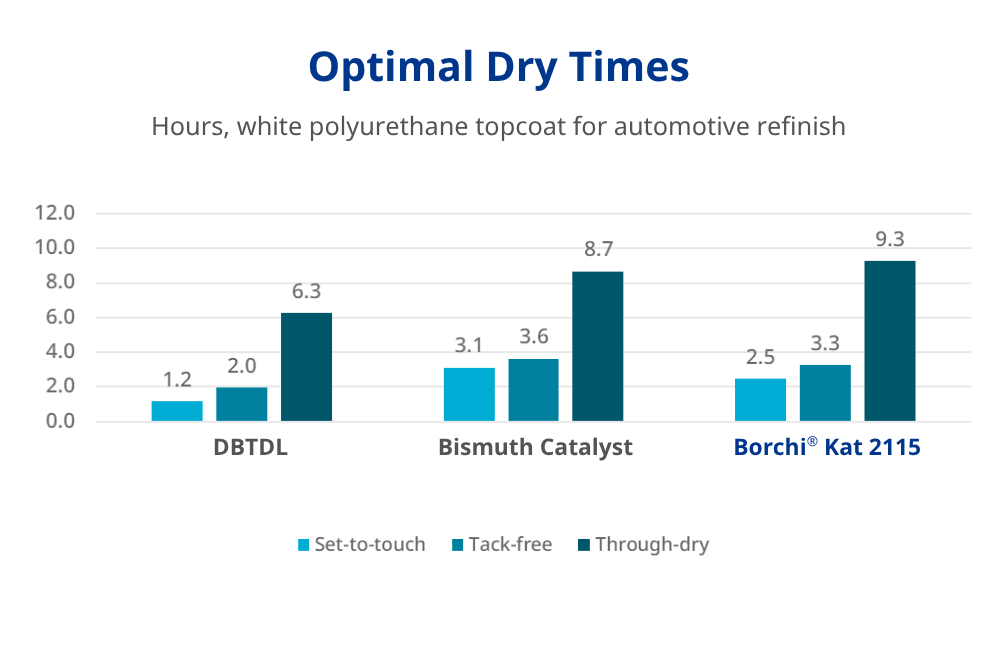
Q: Can a tin-free catalyst offer efficient dry times in DTM systems?
Yes. Borchi Kat 2115 is engineered to create optimal reactivity in one- and two-component polyurethane systems commonly used in DTM applications. Its optimized catalytic activity helps achieve optimal drying times needed for production efficiency, even in demanding environments.
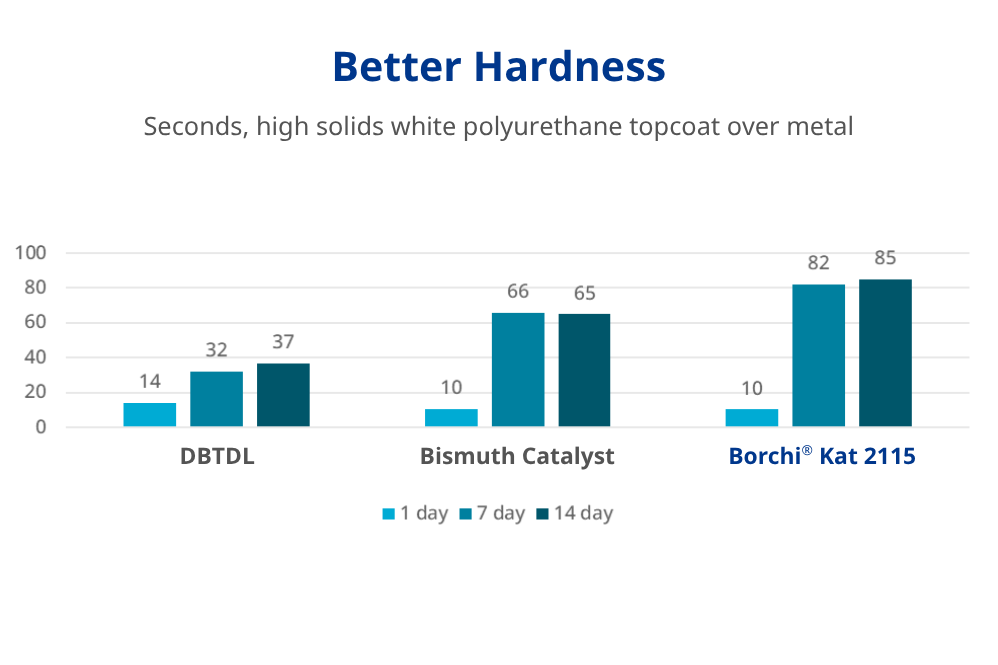
Q: Will switching to a tin-free catalyst compromise hardness or durability?
A: Not with Borchi Kat 2115. During extensive internal testing, the catalyst demonstrated improved hardness performance compared to DBTDL as well as traditional bismuth-based catalysts.
Other benefits include excellent corrosion resistance, making it well-suited for DTM, protective, and heavy-duty industrial environments where long-term durability is essential.
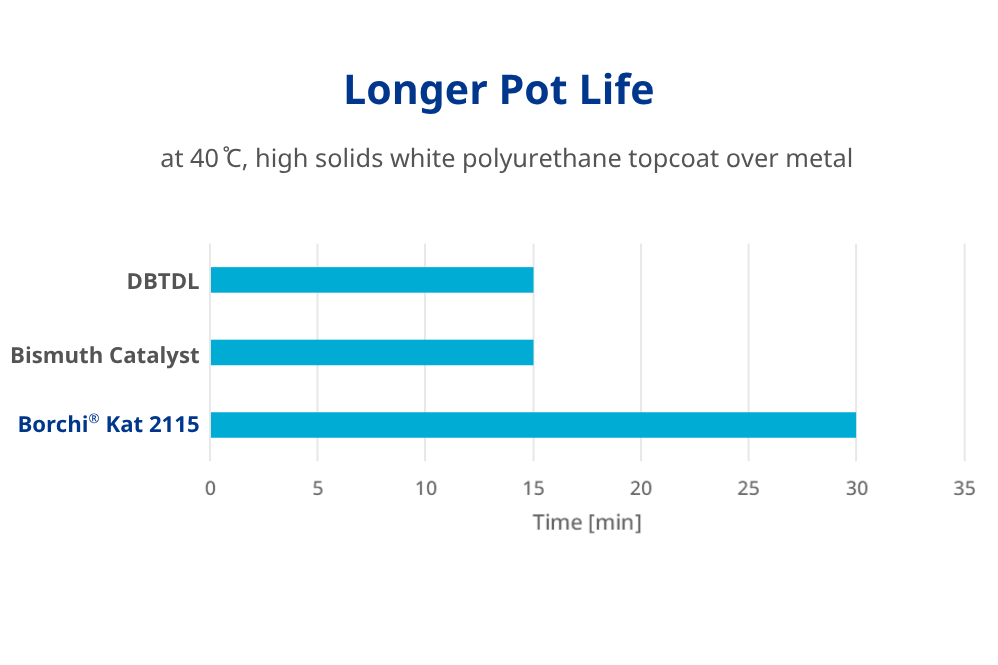
Q: Will switching to a tin-free catalyst compromise pot life?
A: One of the key advantages of Borchi Kat 2115 is its ability to provide longer pot life compared to DBTDL and bismuth catalysts, while still enabling fast cure. That means more application control, less waste, and better consistency across large-scale or complex DTM jobs.
Q: Does a tin-free catalyst affect appearance or color stability?
A: Yellowing and gloss instability are common challenges that DTM coatings may face. Borchi Kat 2115 minimizes these effects, helping formulators achieve:
- High gloss finishes
- Reduced yellowing
- High-quality finish appearance
For DTM coatings where aesthetics and long-term appearance matter, this makes the transition to tin-free systems significantly easier.
Q: Can Borchi Kat 2115 support global compliance requirements?
A: Absolutely. As a tin-free and 2EH-free catalyst, Borchi Kat 2115 helps simplify compliance with regulatory frameworks such as REACH and regional labeling requirements tied to DBTDL and 2-ethylhexanoic acids.
This makes it an ideal option for global manufacturers looking to optimize their DTM product lines.
Advancing Polyurethane DTM Formulations with Confidence
The shift toward tin-free catalysts doesn’t have to mean compromising performance or rewriting your DTM formulations from scratch. With Borchi Kat 2115, formulators gain a catalyst that:
- Achieves optimal dry times
- Provides a longer pot life
- Delivers better hardness
- Improves Labeling
Ready to evaluate Borchi Kat 2115 in your DTM formulations?
Explore the full technical story and see how this catalyst performs across polyurethane systems.
Share

Related Articles

Paint and Coating Additives for your Formulations
What are Coating Additives? Coating additives are a small component of a total formulation that makes a strong impact....
LEARN MORE »
Defoamers for Coatings and Paints
A defoamer is an additive that eliminates foam when making, applying, or storing paint. Foam is a difficult problem for...
LEARN MORE »
5 Ways Additives Improve Direct-to-Metal (DTM) Coating Performance
Direct-to-metal (DTM) coatings work under pressure. From industrial equipment and machinery to exterior structures and metal components, these coatings must...
LEARN MORE »