




Additives for Enhanced Aesthetics in Epoxy Floor Coatings
July 23, 2025 | Blog
Epoxy coatings are a popular option for flooring. Floors installed in kitchens, garages, manufacturing plants, and office spaces are common places where end users apply epoxy paints. These coatings can provide excellent durability, hardness, chemical resistance, and adhesion to concrete in these settings. Epoxy coatings can also be a cost-effective option for end users.
While these coatings provide excellent durability features, surface defects can still occur.
Surface defects that may occur in epoxy coatings include:
- Foam formation
- Haze
- Craters, pinholes, and orange peel
- Syneresis and separation after storage
This can ultimately diminish the final look of a floor coating.
Coating additives can be added to epoxy floor formulations to help maximize the clarity and overall appearance of a final coating.
Benefits provided by additives for epoxy resins used in floor coatings can include:
- Increased foam reduction
- Enhanced surface quality
- Excellent viscosity stability
Borchers provides a range of coating additives to help elevate epoxy floor coating performance.
Foam reduction
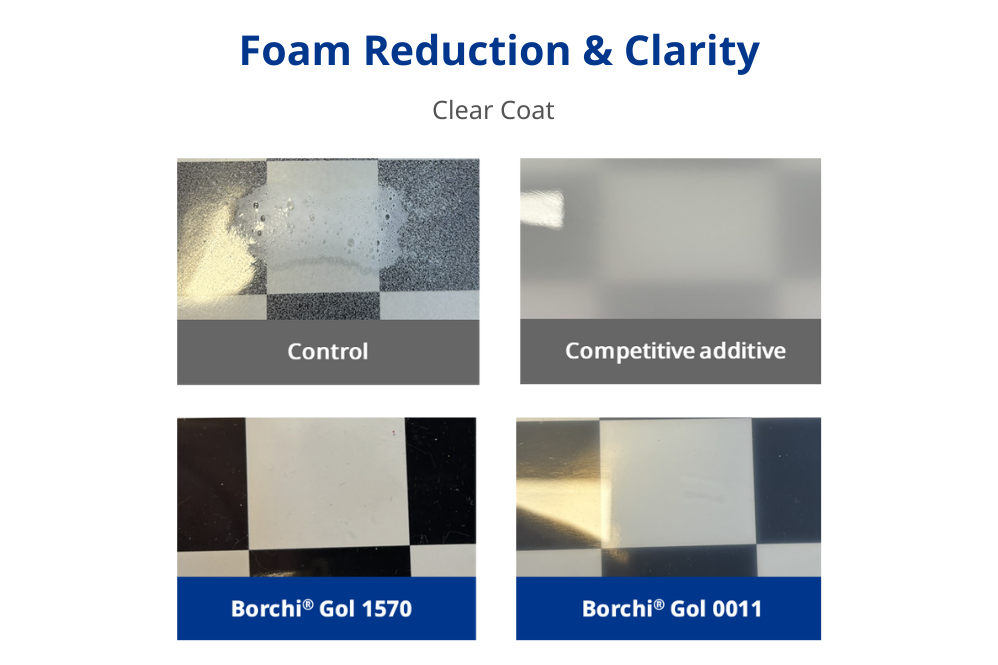
Epoxy coatings may contain air bubbles that result in surface defects. Defoaming additives can destabilize foam at the surface during coating production and application or accelerate the migration of entrapped air to the surface.
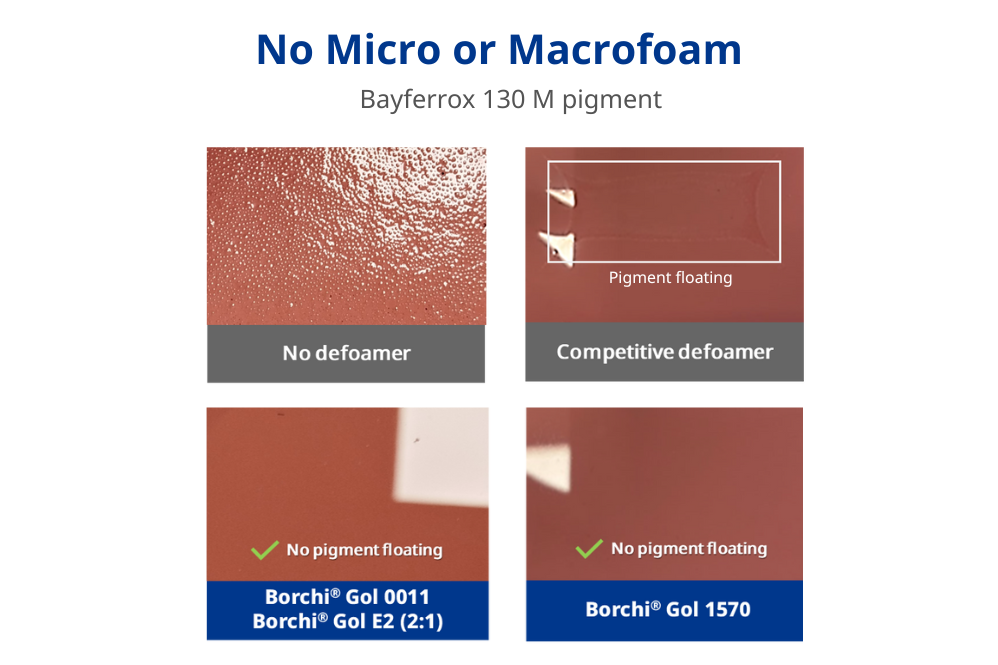
In 2K epoxy solvent-free formulations, Borchi® Gol defoamers helped provide:
- Micro and macro foam prevention
- Reduced pigment floating
- Minimal impact on slip
- Reduced haze
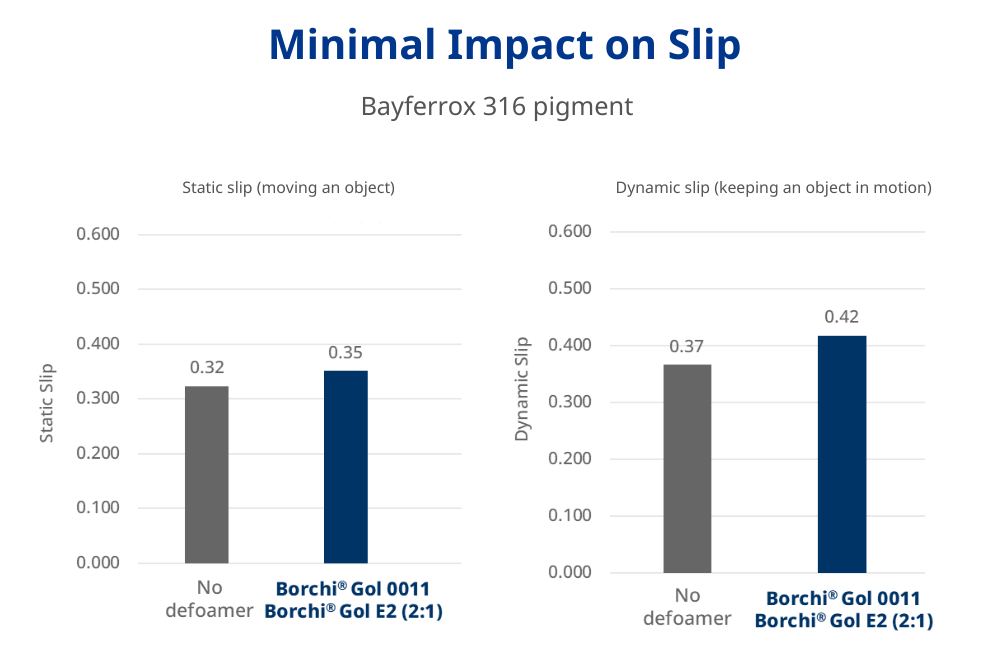
Static Slip/ Coefficient of Friction (SCOF): This measures the frictional force required to start moving an object from rest
Dynamic Slip/ Coefficient of Friction (DCOF): This measures the frictional force required to keep an object in motion
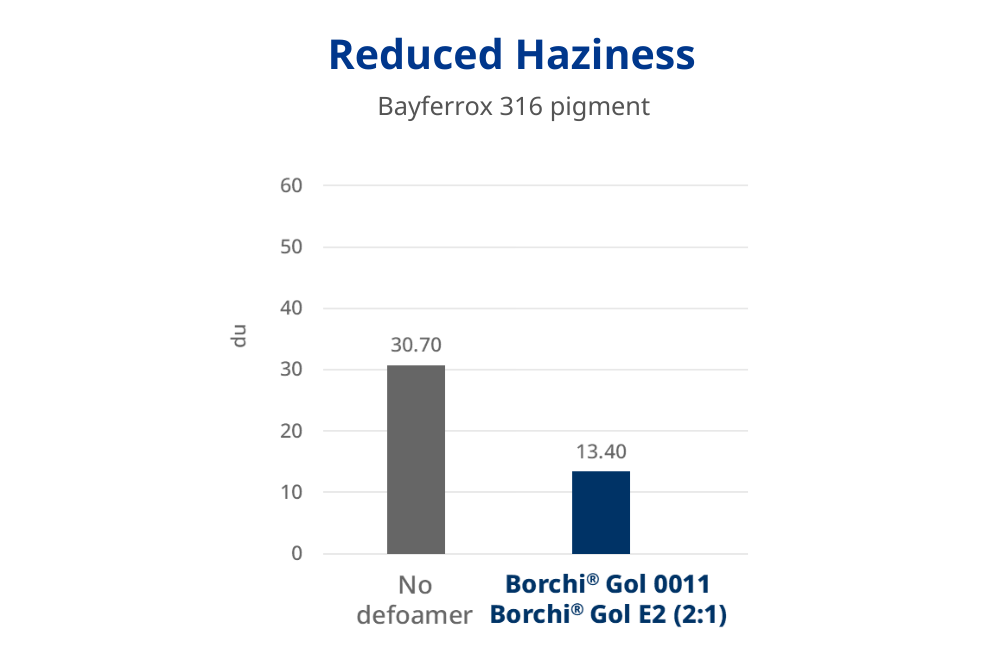
The range for DU values typically goes from 0 to 65; A lower DU value indicates a clearer, sharper reflection, while a higher DU value suggests more haze and less distinct reflections
Defoaming additives for epoxy floor coatings include:
- Borchi® Gol 1570: Polyether-modified PDMS flow, leveling and defoaming additive with cyclosiloxane levels below 0.1% per respective substance
- Borchi® Gol 0011: PDMS defoamer for flow and air release with cyclosiloxane levels below 0.1% per respective substance
- Borchi® Gol E2: silicone-free defoamer for flow and air release
Download the clear coat, red, and gray pigmented formulations
Flow and leveling
High surface tension in coatings can result in orange peel, pinholes, and cratering. Flow and leveling additives are used to reduce surface tension and improve substrate wetting to help prevent these surface defects.
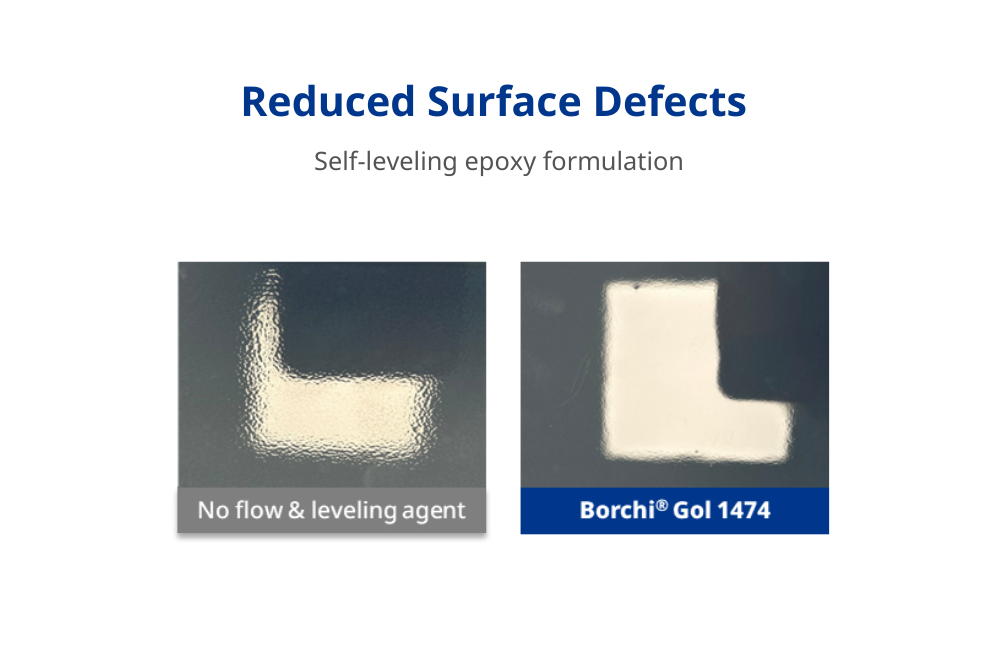
Borchi® Gol 1474 is a polyether-modified polydimethyl siloxane additive for improved slip, flow, and leveling with cyclosiloxane levels below 0.1% per respective substance.
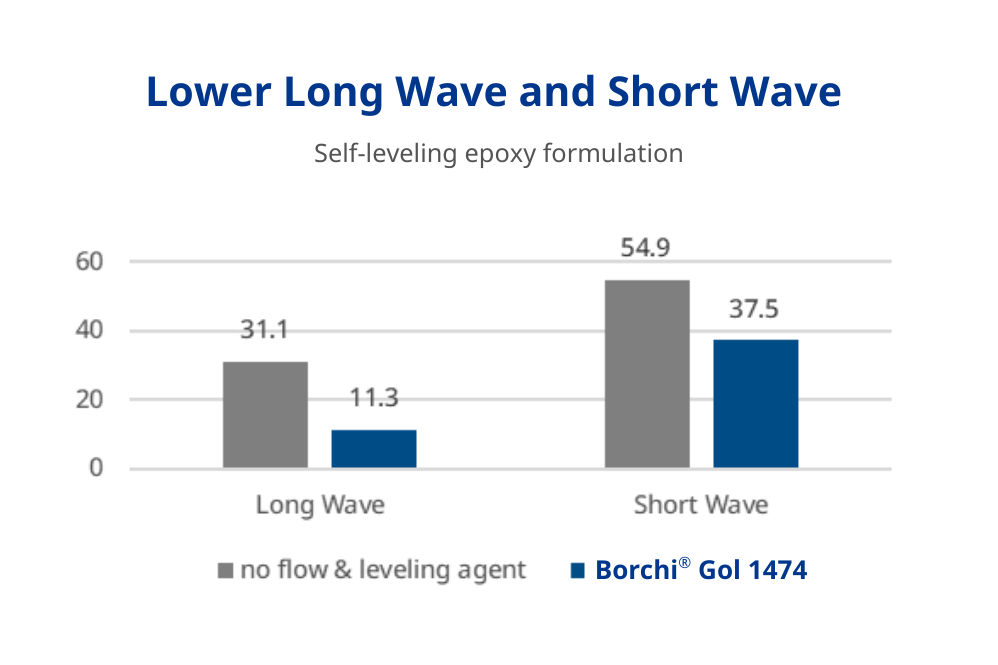
In a 2K epoxy solvent-free self-leveling formulation, Borchi® Gol 1474 provided:
- Reduced surface defects
- Significantly decreased short and long wave (indicative of reduced orange peel)
Download self-leveling epoxy formulations
Viscosity Stability
To achieve optimal coating application over time, the ability of a coating to maintain its viscosity is crucial. The viscosity of a coating can fluctuate after storage due to environmental factors like temperature and aging.
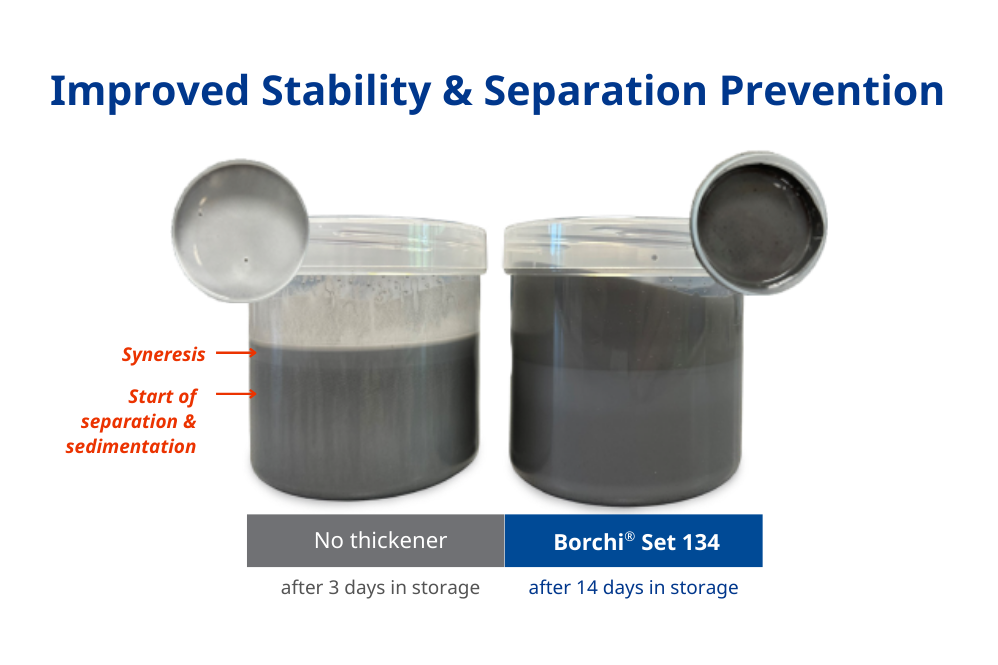
The separation of a coating’s phases (e.g., solid and liquid phases) is one defect that can occur if the viscosity of a formulation cannot remain stable in storage. Syneresis, or liquid forming on the coating’s surface, is also a potential defect.
Borchi® Set 134 is a rheology modifier that can inhibit the hard settling of coatings containing dense pigments. In a 2K solvent-free self-leveling epoxy floor formulation, this additive contributed to excellent viscosity stability and the prevention of separation and syneresis. This product is available for use in Europe.
Download self-leveling epoxy formulations
Summary & Conclusion
Enhancing the durability and aesthetics of popular epoxy floor coatings can contribute to beautifying the environment for end users. Our wide range of Borchers coating additives can help resolve and prevent a variety of defects that may occur in epoxy floor coatings.
For more information on epoxy resin additives, please contact our team.
Share

Related Articles
Architectural Coating Additives: The Key to Better Color, Flow, and Durability
What Really Makes an Architectural Coating Perform? Looking beyond color Architectural and decorative coatings are often judged by what...
LEARN MORE »
Improving Sustainability in Alkyd Wood Coatings with Linseed Oil and High-Performance Catalysts
In recent years, there has been an increased demand for improving the sustainability of coatings for wood. Replacing oils and...
LEARN MORE »
How High-Performance Catalyst Technology Improves Durability in Alkyd Coatings
Why Catalysts are Used in Alkyd Coatings Alkyd coatings are one of the most cost-effective alternatives to epoxies and 2K...
LEARN MORE »