Polyaspartic coatings have rapidly become a preferred technology for commercial, industrial, and decorative flooring applications. They cure at ambient temperatures and do not have a need for post cure, saving energy in environments where downtime must be minimized.
However, formulators often face a difficult balancing act when developing pigmented polyaspartic systems.
While high-performance dispersants are needed to maximize color development, reduce viscosity, and prevent pigment flocculation, they can negatively affect pot life, cure speed, or storage stability.
The result is a common formulation challenge: achieving excellent pigment dispersion without disrupting the carefully engineered reactivity of the polyaspartic system.
Why Polyaspartic Coatings Continue to Gain Popularity
Polyaspartic coatings are a subcategory of aliphatic polyurea technology that offers a unique performance profile compared to traditional epoxy and polyurethane flooring systems.
Key advantages include:
Fast Cure and Rapid Return to Service
One of the biggest advantages of polyaspartics is their ability to cure significantly faster than may other conventional floor coatings. This quicker return to service improves cycle time of jobs and can reduce installation costs.
Excellent Durability
Polyaspartic coatings provide strong abrasion resistance, chemical resistance, and mechanical protection. These characteristics make them ideal for warehouses, manufacturing plants, garages, laboratories, and commercial facilities.
Low-VOC Formulation Potential
Many modern polyaspartic formulations can be designed for very high solids or near-zero VOC content, helping formulators address environmental and regulatory requirements.
Why Dispersant Selection Matters in Polyaspartic Formulations
Pigment dispersants are essential for achieving stable, high-quality color dispersions. A properly selected dispersant can:
Improve pigment wetting
Increase color strength
Reduce viscosity
Improve gloss and appearance
Minimize pigment flocculation
Enhance long-term stability
Have no negative impact on pot life
Unfortunately, not all dispersants are suitable for highly reactive polyaspartic systems.
The Importance of Selecting a Dispersant that does not Compromise Pot Life in Polyaspartic Coatings
For flooring contractors and applicators, pot life is a critical property in coatings. Once Part A and Part B are mixed, the coating must remain workable long enough to allow proper application and to flow out into a nice smooth surface that polyaspartic coatings are known for. A dispersant that delivers excellent color development but significantly reduces working time can create processing challenges.
Excess moisture in the formulation can significantly reduce pot life and adversely affect surface appearance. Additionally, additives with a higher acid number may accelerate the reaction and further shorten pot life.
Evaluation of Borchi® Gen 0451 Dispersant in Polyaspartic Floor Coatings
To evaluate dispersant performance in polyaspartic floor coatings, testing was conducted in both white and gray flooring formulations based on polyaspartic resin technology. The performance of Borchi® Gen 0451 was compared against a competitive dispersant.
Borchi Gen 0451 is a high molecular weight, nonionic, VOC-free dispersing agent designed for organic and carbon black pigments in waterborne and solventborne coatings. Key features include:
Compared with a competitive dispersant, Borchi Gen 0451 achieved:
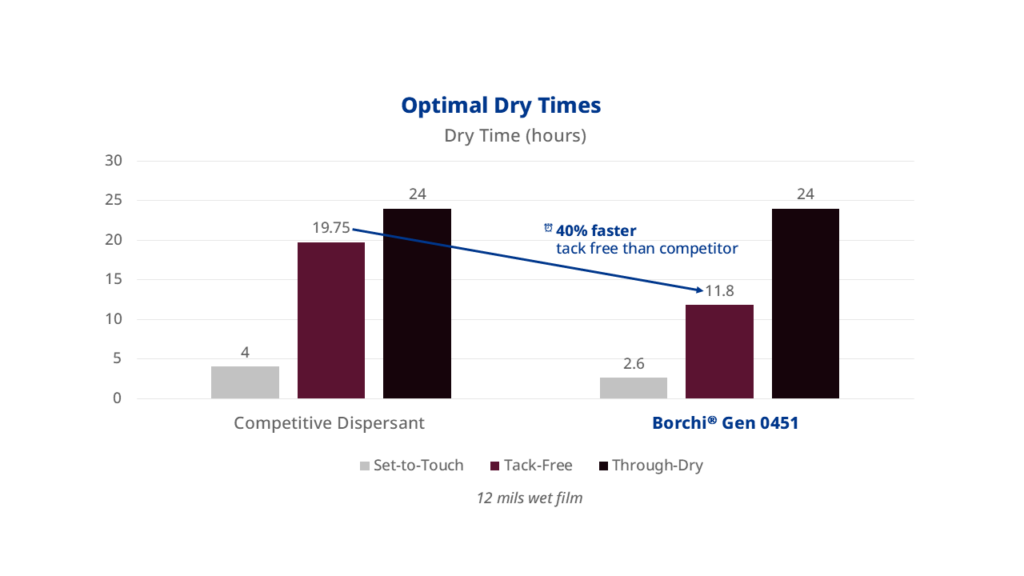
Set-to-touch time: 2.6 hours versus 4.0 hours
Approximately 40% faster tack-free performance (11.8 hours versus 19.75 hours)
This combination is highly desirable because formulators typically expect a tradeoff between pot life and cure speed. In this study, Borchi Gen 0451 delivered faster drying characteristics without reducing usability during application.
Reduced Pigment Flocculation
Flocculation is a common challenge in pigmented coatings and can lead to color inconsistency, appearance defects, reduced gloss, and diminished long-term stability.
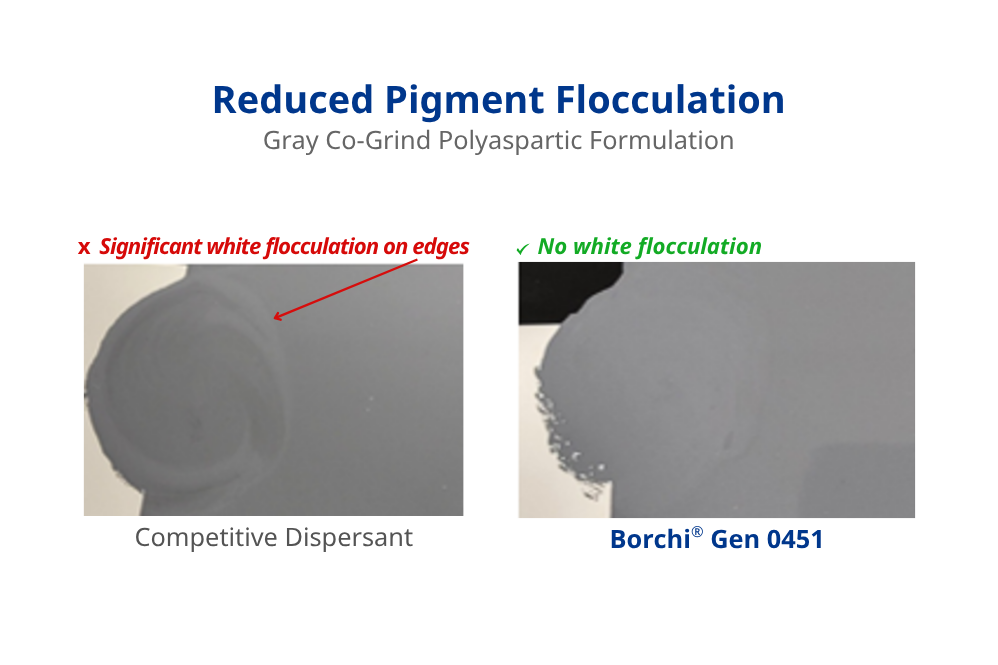
Testing in gray polyaspartic formulations showed that Borchi® Gen 0451 significantly reduced pigment flocculation compared with the competitive dispersant. White flocculation and streaking observed with the competitive product were not present when Borchi® Gen 0451 was used.
This improved stabilization contributes to more uniform color appearance and greater formulation robustness.
Excellent Viscosity Stability
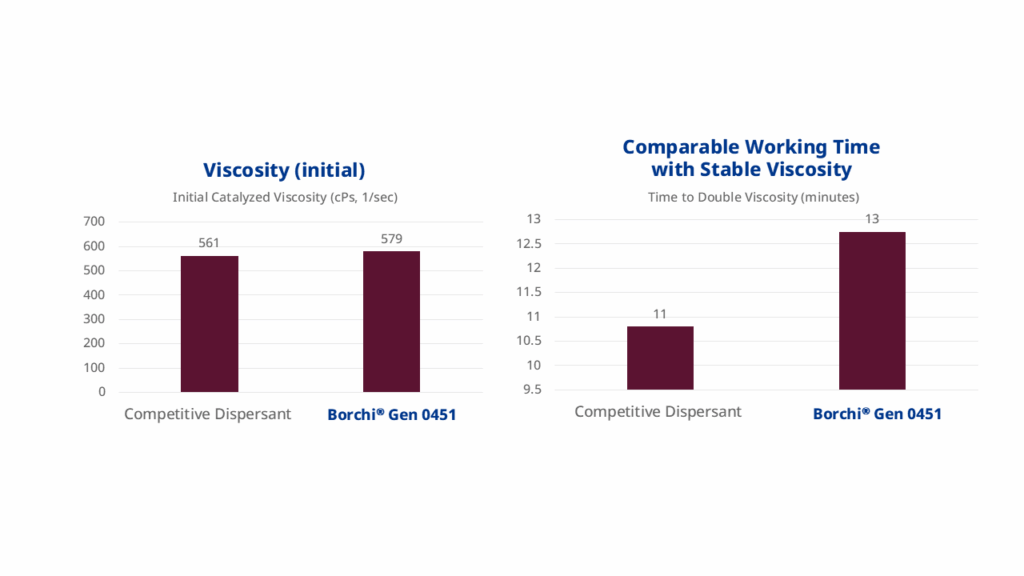
The time required for viscosity to double was:
Competitive dispersant: 10.8 minutes
Borchi Gen 0451: 12.75 minutes, slightly increasing working time for applicators
Initial catalyzed viscosities were also comparable, indicating that the additive did not create processing challenges during application. These results demonstrate that improved pigment stabilization can be achieved without sacrificing working time, a key requirement for contractors and formulators alike.
Maintaining Hardness, Color, and Gloss
Beyond dispersion quality and pot life, finished coating performance remained strong.
Testing demonstrated:
Comparable hardness development
Comparable color metrics
High gloss retention at both 20° and 60°
These results indicate that formulators do not need to trade final coating performance for improved dispersion quality.
Conclusion: Better Dispersions Without Sacrificing Workability
As polyaspartic flooring technologies continue to grow in popularity, formulators need specialty additives that support both performance and processing requirements.
For formulators developing high-performance polyaspartic floor coatings, selecting a dispersant that delivers excellent dispersion without compromising pot life is critical. The data show that Borchi Gen 0451 offers a compelling solution for achieving both objectives simultaneously.
Look for more additives to enhance polyaspartic coatings?
Visit our additives for polyaspartic coatings page for surface additives, adhesion promoters, and more to enhance surface quality and adhesion in rapid-cure polyaspartic coatings.
In automotive refinish applications, few technologies are as important as two-component (2K) polyurethane (PU) clearcoats. These systems are trusted by body shops and refinish formulators because they deliver the combination of appearance, durability, chemical resistance, and long-term weatherability needed to
Polyaspartic coatings have rapidly become a preferred technology for commercial, industrial, and decorative flooring applications. They cure at ambient temperatures and do not have a need for post cure, saving energy in environments where downtime must be minimized. However, formulators
For formulators of alkyd coatings, dry time remains one of the most critical performance metrics. Whether developing architectural clearcoats, industrial enamels, or exterior wood finishes, accelerating cure without sacrificing film performance is essential for both manufacturers and end users. Recent